

With over 26.5 million online stores worldwide, consumers not only expect more from online retailers, but they also have many different options when it comes to buying online. Providing next-level customer support can help differentiate your business and build strong relationships for long-term growth.
What do we mean by average handle time (AHT) exactly?
The average handle time (AHT) is the average amount of time needed to resolve a support request from start to finish. Often, three components are part of the AHT:
What influences the average handle time?
Multiple factors can influence the AHT. These factors can be divided into internal and external factors.
Internal factors
- Agent training and experience
- Ticket complexity
- Available tools and technology
- Information availability
External factors
- Customer communication style and behavior
- Channel type (phone vs. chat vs. email)
- Volume of incoming requests
Why handle times are worth optimizing in e-commerce
Global research on the online customer experience shows that 72% of consumers would abandon a brand after experiencing bad customer service. Time has a big impact on customer satisfaction when it comes to service.
Here’s why optimizing handle time matters now more than ever:
- Build trust: Responding quickly shows you value customers and want to solve their problems quickly. This increases trust in your brand.
- Decrease frustration and dissatisfaction: Minimizing handle times reduces customer stress and provides a more pleasant support experience.
- Increase brand loyalty: Offering quick and effective support helps to create a positive overall experience and to build strong relationships with customers.
- Optimize resources and reduce costs: Besides customer-facing benefits, decreasing handle times also allows you to optimize resources, make your team more efficient, and reduce overall costs.
With over 26.5 million online stores worldwide, consumers not only expect more from online retailers, but they also have many different options when it comes to buying online. Providing next-level customer support can help differentiate your business and build strong relationships for long-term growth.
8 practical tips to decrease handle times in e-commerce
Want to effectively decrease handle times? Then it’s important to tackle the overarching challenges support teams face when it comes to handling times. Let’s understand the key challenges and how to effectively reduce handle times.
1. Integrate communication channels
It’s a no-brainer that working in many different tools, platforms, and systems is very time-consuming and should be avoided whenever possible.
Think about it: you’re getting a question from an online shopper via the chat support in your store. If you have to search through all the different systems to provide an answer, you’re wasting valuable time and increasing the chance your potential customer leaves without buying.
Another thing to keep in mind is when the same person reaches out to you multiple times and via different channels. Questions and answers should be stored at all times. This way, you can stay consistent in your responses.
Luckily, many contact centers and even AI customer support software offer integrations with different systems for communication channels, order tracking, inventory updates, internal knowledge bases, and more.
This allows your team to provide quick and complete answers in no time and reduces the time spent switching between different systems and channels as well.
2. Repetitive tasks and questions - Implement AI to automate routine tasks
With hundreds or even thousands of support tickets in the backlog, chances are high that the same questions are being asked over and over again, which obviously isn’t efficient at all. It also makes the jobs of support agents boring.
You risk your teams being demotivated; they might forget to actually go the extra mile for your customers or, worse, get burned out. All of this can result in longer handle times.
There’s a lot of hesitance to adopt AI when it comes to customer service. You don’t want to give the wrong or impersonal answers to your customers. But the easiest way to start adopting AI in customer service is to automate repetitive tasks. AI solutions help your team to work smarter and cover the repetitive work.
AI can automate routine tasks by:
- Providing the right answer suggestion immediately
- Finding the right information automatically
- Automating data entry and collection
- Labeling and summarizing tickets
- Filtering and routing tickets
- Translating responses
3. Offer the best self-serve options
There are many things you can optimize in your customer-facing processes to reduce handle times per ticket and even the amount of incoming questions overall:
- Create an extensive knowledge base: Use AI to sift through all historical tickets to spot trends and common issues or analyze frequently asked questions. Then make sure to display them on the frontend of your store to reduce the number of questions that come in.
- Offer automated chatbots or virtual assistance: AI-powered chatbots are available 24/7 to tackle easy-to-solve questions.
- Improve order tracking possibilities: WISMO (Where Is My Order) calls can make up over 35% of customer support interactions. You can reduce the need for your support team by proactively sending status updates that go beyond standard order tracking updates. Make sure these updates are integrated into your contact center so your support team is aware at all times. This will reduce overall handle times as well.
- Streamline returns: Allow AI to help your customers with their returns or use software that offers a self-serve portal to reduce the support needed from your customer service team.
- Offer automated recommendations and size advice: Help customers find the right product. Especially when selling technical products, it can be helpful to offer automated but proactive advice in your store. When selling fashion, a fit finder can also help reduce the need for additional support.
When you optimize self-serve options, you can ensure customers are better informed before they ask your customer service team, making it easier for your team to handle questions as well.
4. Optimize workflow automations
Scaling support is hard, so automations should be the first thing to look at. When you’re optimizing support processes, chances are high you don’t need additional team members to provide the best support possible.
We’ve mentioned a few options in tip 2 already, but optimizing workflows with automations can reduce the manual work needed to solve a ticket.
The first thing to look at in terms of workflows is to use AI to automatically route tickets to the best agents, provide answer suggestions, and showcase all information from a customer in one overview.
One point to specifically highlight, which is often overlooked, is to work with feedback loops. Automated feedback mechanisms can feed your teams and AI solutions with better knowledge.
And last but not least, send automated updates to internal communication channels to keep support teams informed at all times about updates, common issues, and best practices.
Eventually, automation can complete 50-70% of all tasks.
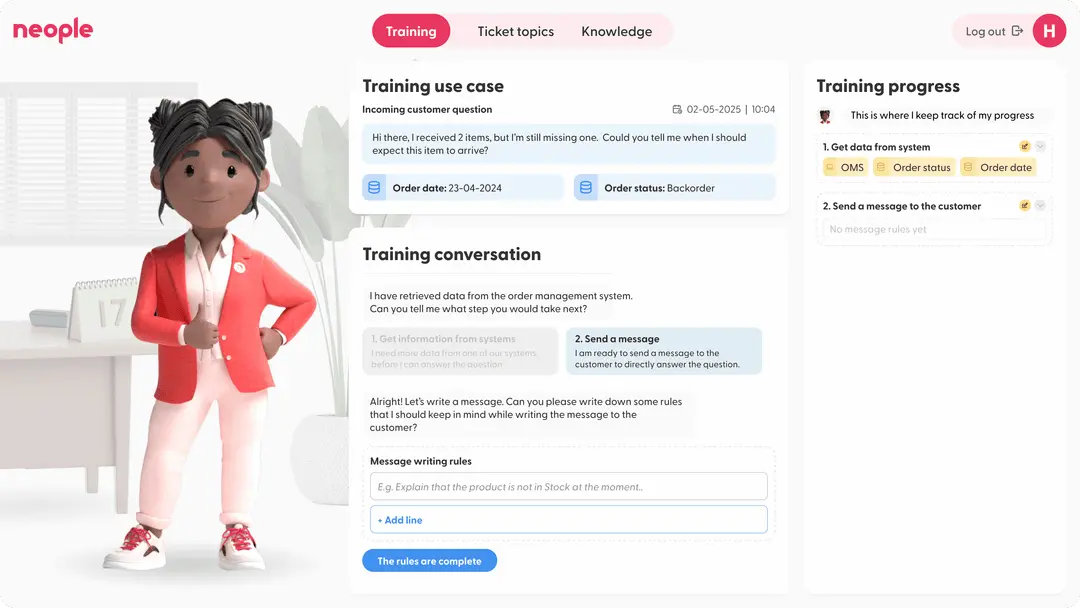
5. Provide the right training for support agents
Your support team can thrive if they have the right tools and knowledge to do their job well. Setting up training programs can be hard, but investing in the right training and onboarding for your team can significantly reduce the time they need to offer the best support possible.
Luckily, AI is here to help as well. Did you know that AI can help new employees get up to speed by quickly offering on-demand training and assistance? This reduces the learning curve and improves the overall efficiency of the whole team.
AI can also help in providing feedback loops and pushing it back to your internal knowledge base. This way, your support team can continuously keep learning. Training programs that encourage collaboration and knowledge sharing among agents help follow best practices and solutions, leading to quicker resolutions.
6. Keep track of performance metrics
Reducing handle times comes with optimized processes. But what processes should you optimize when you don’t know what takes up most of your team’s time? This is where performance metrics come in.
Quite a lot of metrics can give you more insights when it comes to the average handle time:
- First contact resolution
- Average response time
- First response time
- Average hold time
- Average after-contact work, such as updating records
- Call transfer rate
- Escalation rate
- Ticket reopen rate
- CSAT and NPS scores correlate with efficient and effective resolutions
- Amount of tickets solved per agent
- AI suggestion success
Continuously monitoring these different performance metrics can help decrease the average handle time and evaluate how efficient your team is.
7. Enhance team collaboration
Team collaboration is vital to making customer support teams perform better and feel valued. Customer service is often not valued within businesses, leading to inefficient processes and dissatisfied teams.
By improving team collaboration, team knowledge will be increased, and handle times can be decreased by pairing less experienced support agents with senior people. It also helps to balance workloads, preventing agents from being overwhelmed. Stressed team members won’t be efficient in their work.
When working with AI, make sure your agents can collaborate on how to best use it to improve processes. They can also train AI, so it can help save time in the long run. Last but not least, team collaboration leads to a bigger team spirit and therefore happier employees, resulting in faster problem solving.
8. Optimize your knowledge base
Your knowledge base is a goldmine for optimizing all customer support processes. When looking at handle times, a knowledge base can have a big impact. Covering the most frequently asked questions in an FAQ section in your online store can decrease the number of tickets your team receives in the first place.
That’s definitely not all. Every customer interaction can feed new information to the knowledge base. An internal knowledge base can help your support team find the right information more quickly, share it efficiently, and feed it to AI.
This allows AI to give answers or answer suggestions more quickly. You can also use AI to look at historical tickets and create new knowledge articles about common issues. This can lead to more optimized knowledge bases as well.
Why improving customer support in e-commerce goes beyond the AHT
When focusing on improving customer service KPIs, it’s important not to get too tunnel-visioned on optimizing KPIs. While AHT is a great KPI to track, it only tells part of the story.
You want to provide a balance between quantity and quality. Focusing too much on increasing the speed of your handle time can come at the cost of quality service. For instance, you might resolve a ticket faster by just answering a question but miss the bigger picture of what the customer is struggling with.
In the end, it’s all about providing the best possible customer experience by being responsive, accurate, and empathetic. Investing in AI-driven customer service solutions can help address these broader challenges effectively.
.png)

.png)